
LiFePO4 vs Lead-Acid: Why Your Trolling Motor Deserves Lithium
Not sure whether to run your trolling motor on LiFePO4 or lead-acid? We compare weight, usable capacity, lifespan, and true cost per cycle — and show when each battery makes...

Not sure whether to run your trolling motor on LiFePO4 or lead-acid? We compare weight, usable capacity, lifespan, and true cost per cycle — and show when each battery makes...
You bought a trolling motor for silence and precision. Then you haul a 60-lb lead-acid battery into the boat and wonder why it dies by noon — and why the bow sits two inches lower in the water. Here's the uncomfortable truth: on most setups, the battery — not the motor — is the weak link. This is the head-to-head that settles the LiFePO4 vs lead-acid debate for anglers.
If you run your trolling motor more than a handful of weekends a year, LiFePO4 (lithium iron phosphate) wins on almost every metric that matters on the water: it's roughly one-third the weight, you can actually use ~95% of its capacity (vs only ~50% on lead-acid), it lasts 8–10 years instead of 2–4, and it charges in a fraction of the time. Yes, the upfront price is higher. But on a cost-per-useful-cycle basis, lithium is usually the cheaper battery — and it's a dramatically better fishing experience from day one.
The rest of this guide shows the numbers, does the cost math, and tells you exactly when lead-acid is still the right call.
| Spec | LiFePO4 (lithium) | AGM / SLA (lead-acid) |
|---|---|---|
| Weight (per 100Ah) | ~24–28 lb | ~60–70 lb |
| Usable capacity | 80–100% (flat discharge) | ~50% (don't go deeper) |
| Cycle life | 2,000–5,000+ | 200–500 |
| Realistic lifespan | 8–10 years | 2–4 years |
| Full recharge time | 2–4 hrs | 8–14 hrs |
| Maintenance | None (sealed, BMS) | Equalize / top-up |
| Charge efficiency | 95–99% | 70–85% |
| Upfront cost | Higher | Lower |
Figures are typical ranges for quality deep-cycle batteries; exact numbers vary by brand and model.
Upfront price is where lead-acid wins and lithium "loses" — on the shelf. On the water, over the life of the battery, it flips completely. Here's a realistic example for a 12V 100Ah bank:
| Over 5 years of weekend use | LiFePO4 | AGM lead-acid |
|---|---|---|
| Batteries bought | 1 | 2–3 |
| Usable Ah per trip | ~95 Ah | ~50 Ah |
| Time hauling weight | ~25 lb | ~65 lb × 2–3 |
Because you can safely use almost twice the rated capacity and the pack outlives two or three lead-acid batteries, the cost per usable amp-hour over the battery's life is typically far lower with lithium. You also stop buying (and heaving) heavy batteries every couple of seasons.
This is the stat most anglers miss. A lead-acid battery should never be discharged below 50% or you wreck its lifespan — so a "100Ah" AGM really gives you ~50 usable Ah. A LiFePO4 can be drawn down to 80–100% routinely thanks to its flat discharge curve and built-in BMS. Net result:
Be fair to lead-acid — it's not obsolete:
If none of those describe you, lithium is the better tool.
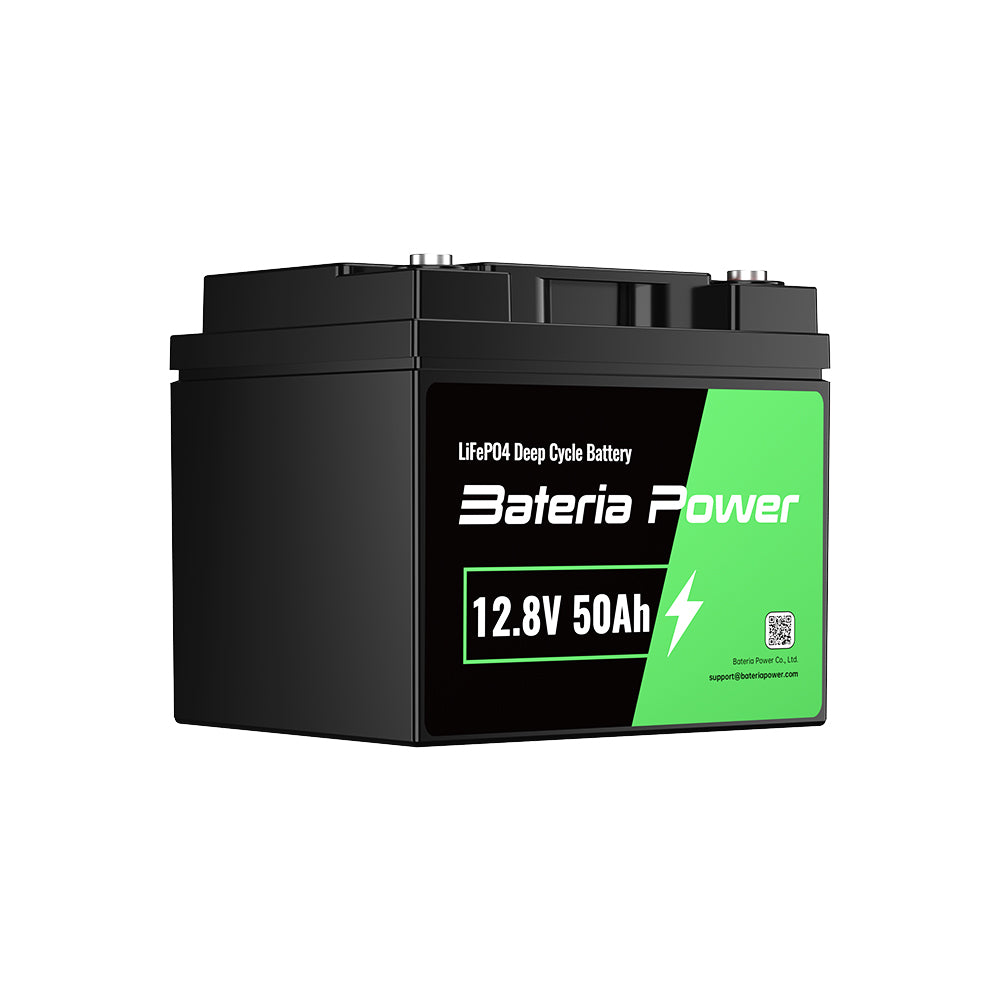
From $98.00 Choose options
Our dedicated trolling-motor battery. Compact and light — ideal for 12V bow motors, kayaks, and shorter trips where every pound counts.

$320.00 $208.00 Save 35%
Built marine-grade with Bluetooth & self-heating (Pro). Run a 12V motor all day, or two in series for 24V/36V systems. The all-day angler's pick.
Either way, connect it properly: a high-current draw like a trolling motor deserves a 50A marine plug & receptacle (elbow or straight) instead of alligator clips — see our Elbow vs Straight guide.
Can I just drop a LiFePO4 into my existing motor?
Yes — voltage is voltage. A 12V lithium replaces a 12V lead-acid directly; size the Ah to your motor's draw and trip length.
Is lithium safe on a boat?
LiFePO4 is the stable chemistry — no thermal runaway like other lithium types, sealed, and our cells ship with a BMS that manages over/under-voltage, current, and temperature.
Do I need a new charger?
Ideally yes — a LiFePO4/lithium profile charges faster and protects the pack. A basic AGM charger will "work" but charges slowly and may never hit absorption correctly.
How long will it last?
8–10 years / 2,000–5,000 cycles of normal use — typically 3–4× a quality AGM.
Ready to lose the dead weight?
Shop LiFePO4 batteries built for trolling motors — and read our Trolling Motor 101 to size your whole setup.
Shop Trolling Motor Batteries →BateriaPower Marine · Deep-cycle lithium for boats, RVs, and off-grid. Prices and promotions reflect the store listing at time of writing.
Your cart is currently empty.
Start Shopping