The season's over, the boat's on the trailer, and your trolling motor battery is headed for the garage. Stored the wrong way, a battery quietly loses capacity all winter — and a lead-acid pack can sulfate into a paperweight by spring. Here's how to put a LiFePO4 away correctly and bring it back to life when the water warms up.
Why storage actually matters
A battery at rest isn't doing nothing — it's slowly discharging and, depending on chemistry, degrading. The two chemistries behave very differently on the shelf:
|
Lead-Acid (FLA / AGM) |
LiFePO4 (Lithium) |
| Self-discharge / month |
~5% (FLA higher) |
~2–3% (very low) |
| Left discharged all winter |
Sulfates → permanent loss |
Survives, just recharge |
| Memory of "empty" |
Yes (capacity fades) |
None |
| Realistic shelf life untouched |
Risky past 1–2 months |
Months with a top-up |
The takeaway: a LiFePO4 is far more forgiving in storage — but "forgiving" isn't "indestructible." Do it right and you protect that 4,000–8,000-cycle lifespan.
Rule #1 — store at the right charge (not full, not empty)
For long-term storage, aim for about 50% state of charge (30–60% is fine). Why not 100%? Holding a cell at full voltage for months accelerates calendar aging. Why not near-empty? A pack that self-discharges below the BMS cut-off over winter can sit at 0V, and reviving a deeply depleted LiFePO4 is harder (and sometimes impossible) than a gentle 50% rest.
Quick method: After your last trip, run the motor until the battery reads roughly half on your gauge, or charge to ~50% with a capable LiFePO4 charger. Don't obsess over the exact % — "around half" is the safe zone.
Rule #2 — temperature: cool & dry, and never charge below freezing
LiFePO4 is chemically stable across a wide range, but two temperature facts matter for storage and care:
-
Store cool, not freezing. A dry garage or basement around 10–20°C (50–68°F) is ideal. Avoid uninsulated sheds that drop below 0°C for long stretches — cold itself won't kill the cells, but it raises the risk if you forget Rule #3.
-
Never charge a LiFePO4 below 0°C / 32°F. Charging lithium near or below freezing drives metallic lithium plating on the anode — a permanent, unsafe capacity loss. This is chemistry law, not a brand quirk.
If you must top up in winter, only charge indoors at room temperature, and let the battery warm to above freezing first.
Rule #3 — your BMS is still on duty
Even sitting in the garage, the battery's management system is watching. Our 12V 100Ah Pro carries a built-in 100A BMS that guards against over-charge, over-discharge, overload, overheating, and short circuits. That means a stray voltage spike, a warm day that nudges the pack, or a faulty charger can't silently cook the cells while it rests. Quality BMS protection is exactly why a LiFePO4 lives 10 years where a lead-acid gives you 2–3.
Rule #4 — where to store (myth-busting)
| Myth |
Reality for LiFePO4 |
| "Never store on a concrete floor" |
Old lead-acid advice (case sweat + discharge). A sealed LiFePO4 is fine on concrete — just keep it dry. |
| "Leave it on the trickle charger forever" |
Not needed. Float-charging LiFePO4 long-term stresses it. Store at ~50%, check every 3 months. |
| "A warm attic is best" |
Heat ages cells faster. Cool & dry beats warm & dry. |
How long can it sit?
With ~2–3% self-discharge per month, a half-charged LiFePO4 loses maybe 15–20% over a 6-month off-season. Set a calendar reminder to check every 3 months: if it's dropped below ~30%, give it a partial top-up back toward 50%. That's the entire maintenance commitment.
Spring wake-up checklist
| Step |
What to do |
| 1. Inspect |
Look for swelling, corrosion on terminals, or damaged casing. Any of these → contact support before use. |
| 2. Warm up |
Bring to room temperature (above 0°C) before charging. |
| 3. Charge full |
Use a LiFePO4-compatible charger; charge to 100% and confirm it holds voltage. |
| 4. Check connections |
Clean terminals, verify your 50A plug & receptacle is dry and sealed (IP67), re-torque lugs. |
| 5. Test under load |
Run the motor at half throttle for a few minutes; watch for voltage sag or fault lights. |
| 6. Re-water & go |
(LiFePO4: no watering.) Launch and fish. |
The batteries built to sit all winter

12V 100Ah Pro LiFePO4 Marine Battery
$321.00 $208.00 Save 35%
100A BMS, 26 lbs (half a lead-acid's weight, 2× the usable capacity), 4,000–8,000 cycles, 10-year design life. Built for bass boats, pontoons, and 24V/36V rigs.
View 100Ah Pro →
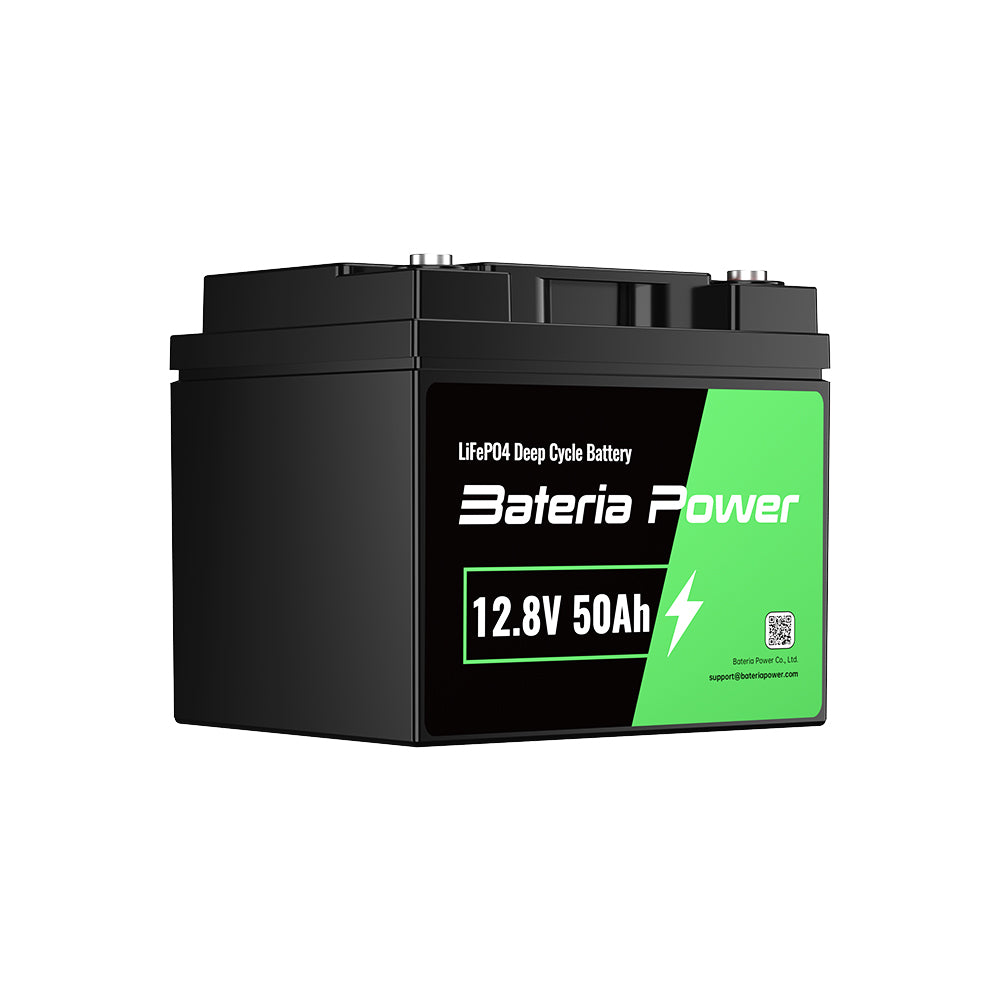
12V 50Ah LiFePO4 Battery (for Trolling Motor)
From $98.00 Lightweight
The go-to for kayaks, jon boats, and 12V 40–55 lb motors. Same LiFePO4 chemistry and low self-discharge — sits all winter with one check-in.
View 50Ah →
FAQ
Can I just leave the battery on the charger all winter?
No. Float-charging LiFePO4 for months stresses the cells. Store at ~50% and check every 3 months.
Is an unheated garage OK?
Usually yes, as long as it stays above freezing for the storage period. If it dips below 0°C, that's fine for storage — just never charge until it warms above 0°C.
How long can a LiFePO4 sit unused?
Months. At ~2–3% self-discharge/month, a half-charged pack needs only a top-up check every quarter.
What about my old lead-acid?
If you're still running one, store it fully charged and put a maintenance/float charger on it — lead-acid self-discharges faster and sulfates if left low. (This is half the reason anglers switch to LiFePO4.)
My battery reads 0V after winter — dead?
Maybe. A LiFePO4 that dropped below the BMS cut-off can sometimes recover with a slow LiFePO4 charge; if it won't take a charge, contact support.
Store it right, fish longer next season
A LiFePO4 rewards good storage with a 10-year life. Pick the size your hull needs and winterize with confidence.
Shop Marine Batteries →
Prices reflect the store listing at time of writing and may vary by configuration — confirm on the product page before ordering. Internal links to related posts (battery sizing, LiFePO4 vs lead-acid, solar charging, electrical safety) should be added once those articles are published.

