
Why Your Trolling Motor Keeps Losing Power — 7 Diagnoses & Fixes
Why does your trolling motor bog down? We walk through 7 common power-loss causes — battery curve, runtime, BMS trips, fouled prop, voltage drop — with a 4-step diagnosis flow...

Why does your trolling motor bog down? We walk through 7 common power-loss causes — battery curve, runtime, BMS trips, fouled prop, voltage drop — with a 4-step diagnosis flow...
You're on a fish, the wind picks up, and your bow-mount motor suddenly bogs down to a crawl. Before you blame the motor, know this: 90% of "weak trolling motor" complaints trace back to the power system — battery, wiring, or connection — not the motor itself. Here's how to diagnose it like a pro.
A trolling motor is a voltage-hungry device. Thrust is a direct function of battery voltage under load. Two things decide whether you feel full power:
| Symptom | Likely cause | Fix |
|---|---|---|
| Power fades as the day goes on | Low SOC / lead-acid voltage sag | Recharge; switch to LiFePO4 for flat curve |
| Runtime far shorter than rated | Undersized Ah / only 50% usable (lead-acid) | Size battery properly; use LiFePO4 ~95% usable |
| Cuts out, then works again | BMS over-current / loose arc / thermal | Check load, tighten, let cool |
| Spins but no thrust | Weed wrap / sheared pin / fouled prop | Clear debris; replace shear pin |
| Weak even at full throttle from the start | Battery too small / thrust mismatched to load | Upsize battery; match lb to hull |
| Voltage drops at the plug | Corroded / loose 50A connector | Clean & seat IP67 plug; inspect |
| Hot motor / burning smell | Overload / bound prop / thin wire | Free prop; upgauge wire; reduce load |
Lead-acid voltage falls steadily as it discharges, so a 12V pack at 50% might read 12.0V instead of 12.7V — and the motor feels it. A LiFePO4 stays near 13.0–12.8V almost the whole discharge, then the BMS disconnects at empty. If your power "fades," you're watching a lead-acid sag. Fix: recharge sooner, or move to LiFePO4 for consistent thrust.
A 100Ah lead-acid only gives you ~50Ah before voltage sags badly. A 100Ah LiFePO4 gives ~95Ah. So a "100Ah" lead-acid and "100Ah" lithium are not the same runtime. Fix: use the runtime formula (Ah × usable% ÷ amp draw) and size from there — see our battery-sizing guide. Upsize if you routinely run out.
Intermittent cut-outs are the classic sign of either (a) the BMS tripping on over-current/over-temp and auto-resetting, or (b) a loose connection arcing open under vibration. Fix: tighten every terminal and lug, confirm your wire gauge matches the run (see our electrical-safety guide), and let the motor cool if it's been at full throttle in weeds.
If the prop turns but the boat doesn't move, you've got weeds, fishing line, or a sheared prop pin (transom mounts) binding the blades. Fix: tilt up, clear the wrap, replace the shear pin. Check the prop for cracked blades too.
A 30 lb motor on a 16-ft bass boat with two anglers will always struggle, no matter the battery. Fix: match thrust to hull and load (rule of thumb ~2 lb per 100 lb of boat+gear); if you're already at the right thrust, the battery is too small — go bigger Ah or higher voltage.
A quick test: measure battery voltage, then measure at the motor plug under load. A gap of more than ~0.5V means resistance in the path. The usual culprit is a corroded or loosely seated connector. Fix: use a sealed, IP67-rated 50A plug & receptacle, keep the contacts clean and greased, and make sure it's fully locked. (Our heavy-duty 50A elbow and straight connectors are built for exactly this.)
Heat means the motor is pulling hard against something — a bound prop, an overload, or thin wiring forcing it to work harder. Fix: power off, free the prop, verify wire gauge, and reduce throttle. Persistent heat can cook the windings; don't ignore it.
| Step | What to check |
|---|---|
| 1. Battery voltage | Resting & under load. Low? Charge or upsize. |
| 2. Connections | Terminals tight? Plug seated & clean? No corrosion? |
| 3. Prop & thrust | Free of weeds/line? Blades intact? Shear pin OK? |
| 4. Wire gauge | Matched to run length & amps? No warm spots? |

$321.00 $208.00 Save 35%
Flat voltage curve all day, 100A BMS, ~95% usable capacity. The fix for fading power and short runtime.
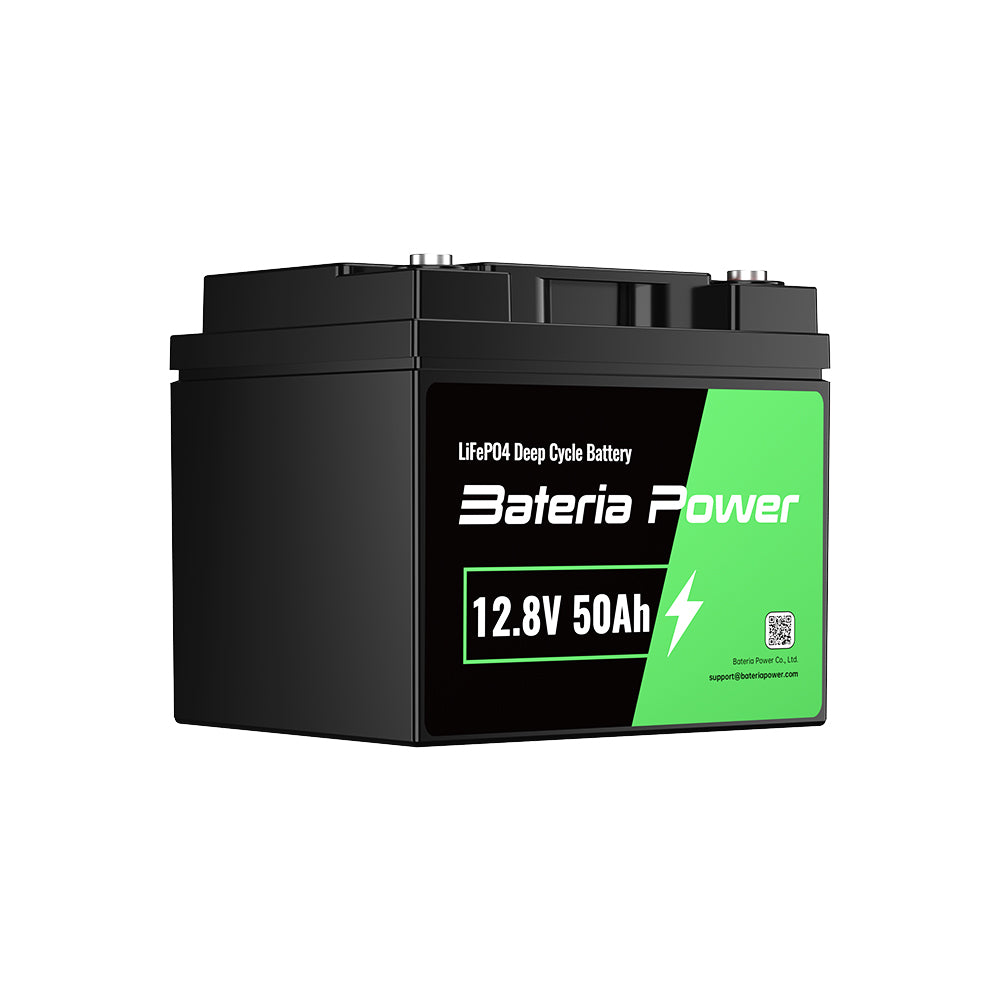
From $98.00 Lightweight
The right size for 12V 40–55 lb motors and kayaks/jon boats. Same flat-curve chemistry.
And stop the voltage leak at the source with a sealed 50A plug & receptacle — browse the elbow & straight connectors →
Why is my brand-new motor still weak?
New motor + weak battery = weak thrust. Check voltage under load first; the motor is rarely the fault.
LiFePO4 or lead-acid for steady power?
LiFePO4, every time — flat voltage curve and ~95% usable capacity mean consistent thrust till empty.
How do I know if my wire is too thin?
If the wire or lugs feel warm at full throttle, it's undersized. Match gauge to run length and amp draw.
Motor cuts out only in weeds — normal?
It's the BMS protecting an overloaded motor. Clear the prop and ease off; if it keeps tripping on open water, check sizing.
Can a loose plug really drop thrust?
Yes — resistance at a bad connection steals volts before they reach the prop. A sealed, locked 50A plug fixes it.
Diagnose the power system, then build one that holds full thrust all day. Start with the right LiFePO4.
Shop Marine Batteries →Prices reflect the store listing at time of writing and may vary by configuration — confirm on the product page before ordering. Internal links to related posts (battery sizing, plug comparison, electrical safety, LiFePO4 vs lead-acid) should be added once those articles are published.
Your cart is currently empty.
Start Shopping