
7 Trolling Motor Battery Myths — Busted (So You Don't Waste $200)
Don't believe everything about trolling motor batteries. We bust 7 common LiFePO4 myths — cold-weather charging, usable capacity, chargers, cost per cycle, fusing, and thrust sizing.

Don't believe everything about trolling motor batteries. We bust 7 common LiFePO4 myths — cold-weather charging, usable capacity, chargers, cost per cycle, fusing, and thrust sizing.
LiFePO4 has gone mainstream for trolling motors — and so has the bad advice. Before you size, buy, or wire your battery, here are the seven myths we hear most, and what's actually true. Skip the $200 mistake.
Cold = dead battery, don't bother.
Truth: The real rule is narrow: don't charge LiFePO4 below 0°C / 32°F. Discharging and storage in the cold are fine — and a lithium cell actually holds voltage better in the cold than a lead-acid does. So your winter trips still work; you just bring the battery inside to charge. (Full winter rules in our storage guide.)
Just double the Ah and you're matched.
Truth: It's about usable capacity, not the label. A LiFePO4 safely delivers ~95–100% of its rated Ah; a lead-acid only ~50% before voltage sags. So 100Ah lithium ≈ 100Ah usable, while a 100Ah lead-acid gives you ~50Ah usable — you'd need ~200Ah of lead-acid to match. The lithium isn't "twice the capacity," it just actually delivers what it's rated. (See the sizing math.)
A trickle charger is a trickle charger.
Truth: Lead-acid and LiFePO4 want different charge profiles (absorption voltage, cutoff, balance). A plain automotive/lead-acid charger won't balance the cells and can leave the BMS confused or under-charged. Use a LiFePO4-rated charger — or an MPPT if you run solar. (Wiring it right is in the install guide.)
Cheaper upfront = cheaper overall.
Truth: Up front, yes. Over life, no. A LiFePO4 runs 2,000–6,000+ cycles vs ~300–500 for lead-acid, and you can actually use most of its capacity. Work it out per cycle and lithium is usually the cheaper power. (The full cost breakdown is in our LiFePO4 vs lead-acid post.)
Concrete drains the charge.
Truth: That was true for old flooded lead-acid with porous cases; modern sealed batteries (lead-acid AGM and all LiFePO4) don't self-discharge through a floor. Store your lithium somewhere cool, dry, and at ~50% charge — the floor material is irrelevant. (Storage details in the winterizing guide.)
Max out the pounds, you'll never regret it.
Truth: Thrust should match your hull weight, not your wish list. Oversized thrust pulls more amps for the same result and drains your battery faster. Pick thrust by boat weight (roughly 2 lb per 100 lb loaded), then size the battery to that draw. (Match it by boat in our boat-type guide.)
Smart battery, no fuse needed.
Truth: The BMS protects the cell (over-charge, over-discharge, over-temp). It is not a downstream short-circuit protector for your wiring. A fuse or resettable breaker within 7 inches of the positive post is still mandatory — that's what stops a chafed wire from cooking. (The wiring rules are in our electrical safety guide.)
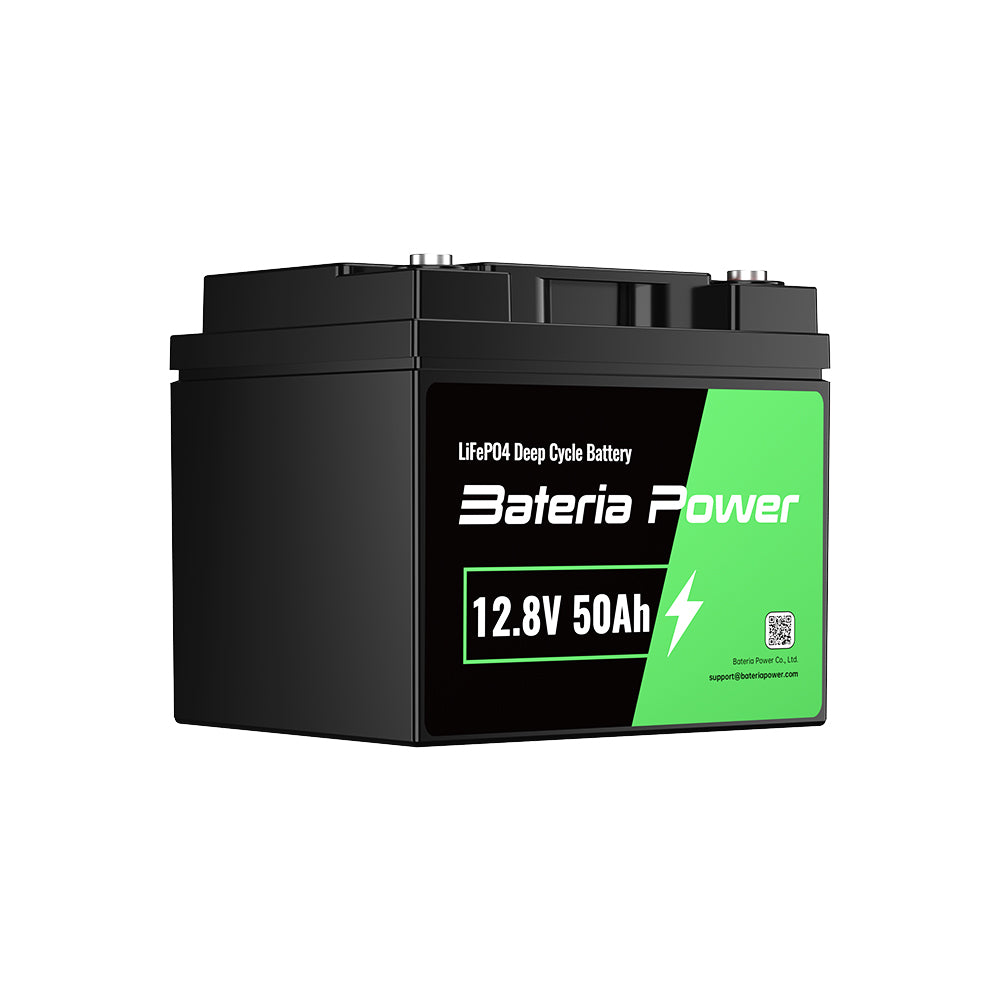
Lightweight, ~95%+ usable capacity, 6000+ cycles. The weekend-angler size.

For all-day runs, 24V/36V banks, or house loads. 100A BMS, 10-year design life.
Is LiFePO4 safe on a boat?
Yes — far more stable than other lithium chemistries, with a BMS handling over-current, over-temp, and short protection. Pair it with proper fusing and sealed connections and it's a safe, standard marine setup.
Can I mix lithium and my old lead-acid?
Not on the same bank. Different charge profiles and voltages will fight each other. Run one chemistry per circuit.
Do I need a special mount?
Just a vibration-rated strap or box so it can't shift. The battery itself is sealed and happy in any orientation.
Note: Battery prices vary by variant and subscription — confirm the live price on each product page before ordering. Internal links marked "#" should be replaced with the real blog URLs once those posts are published.
Your cart is currently empty.
Start Shopping